 gitum
gitum manual
Contents
gitum helps you develop in parallel with an external upstream and stay in sync with it. It is meant for distribution packages that carry patches, forks with hundreds of local changes (wine-rebased), and series of changes waiting to be accepted upstream. At any time it shows where each of your changes stands relative to upstream.
Ideas
- Layers. Your changes live in ordinary git branches stacked on top of
an upstream, for example
winehq→rebased(wine-staging) →rebased-basealt→rebased-etersoft. You work in them with plain git. - One-pass sync.
gitum syncmoves the whole stack onto a new upstream release in one pass. It works in a private work tree, and all branches move in one atomic step at the end. A conflict stops the run without touching anything; you resolve it and continue. - Every change is accounted for. Each change is classified as applied cleanly, resolved (and by whom: rerere, your rules, an agent, a person), already upstream, dropped as a backport, dropped because of its known fate, or removed as a patch + revert pair.
- The journal. The
gitum/journalbranch is append-only, with one commit per published state: layer bases and tips, change ids and fates, series, sync reports, and a shared rerere cache. The layer branches are rewritten, but the journal and the per-layer history branchesgitum/history/<layer>only grow. That makes them safe to share, andgit log -pandgit bisectwork across your states. - Changes have identities and fates. gitum follows a change through every
rebase without rewriting commits. Its fate can be: local, sent upstream
(PR), merged as a given commit, merged with modifications, fixed
differently, distro-only, backport, disabled.
gitum status --changesshows what each change needs. - Series. A series is a named set of changes on its own branch, with dependencies, bugs, merge requests and a state. The journal stores series in the wine-staging layout, so they can be imported from and exported to wine-staging style directories.
Pictures
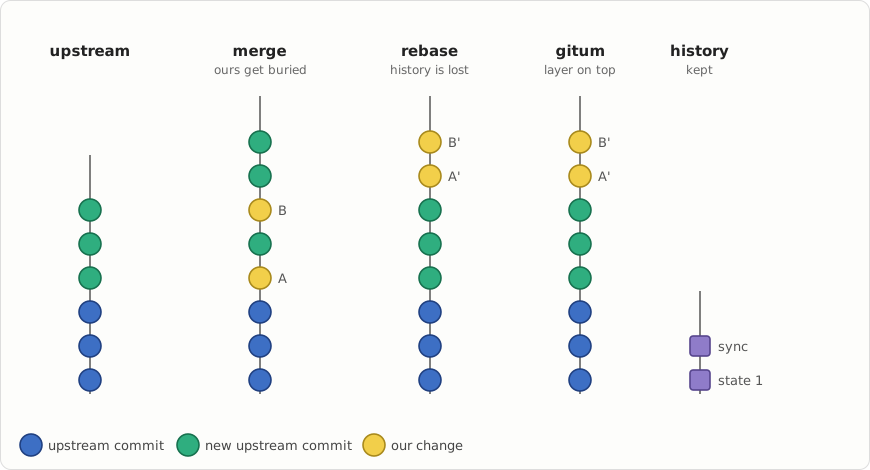
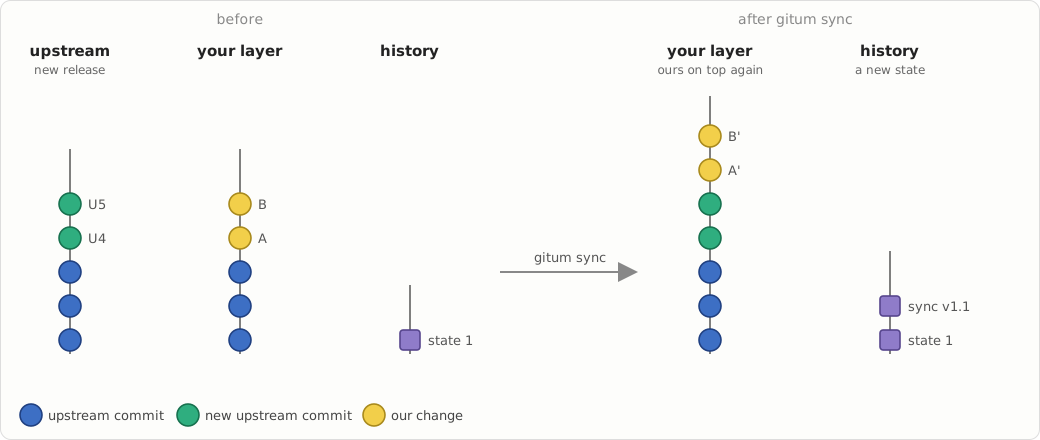
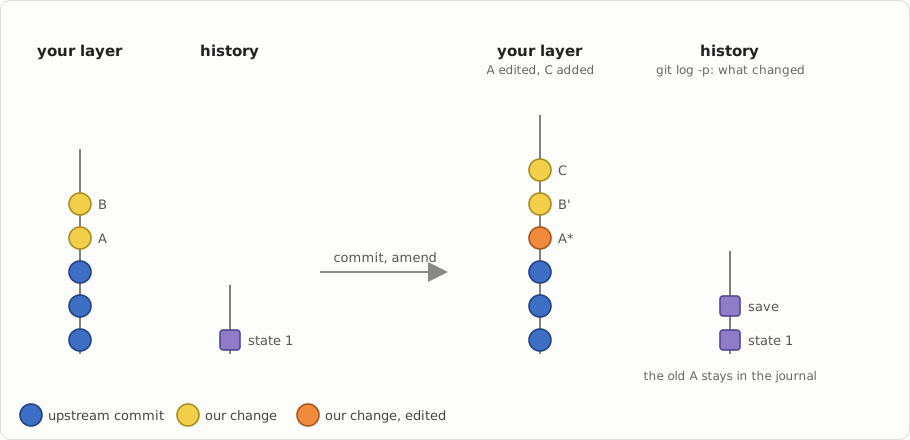
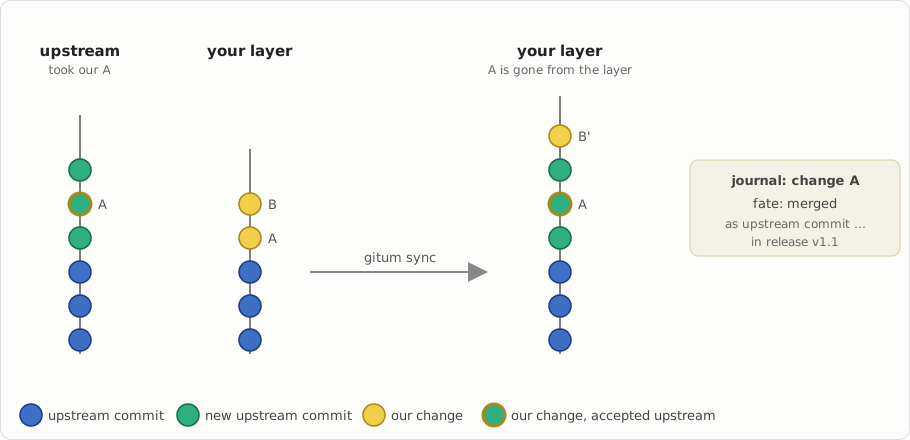
In the pictures blue dots are upstream commits, green dots new upstream commits, yellow dots our changes, purple squares the recorded states of the history branch.
Why gitum: merge buries our changes, rebase loses their history, gitum keeps both.
A new upstream release: gitum sync puts our changes on top again and records a new state.
Our own work with plain git (new commits, an edited old one): gitum save records it.
Upstream accepted one of our changes: the next sync drops it from the layer by itself.
How it works
A stack of layers moves to a new upstream in one pass
flowchart LR
  subgraph before["before"]
    direction BT
    U1["winehq<br/>wine-11.19"] --> S1["rebased<br/>wine-staging"] --> B1["rebased-basealt<br/>15 patches"] --> E1["rebased-etersoft<br/>156 patches"]
  end
  subgraph after["after gitum sync --next-release"]
    direction BT
    U2["winehq<br/>wine-11.20"] --> S2["rebased<br/>rebuilt from wine-staging v11.20"] --> B2["rebased-basealt<br/>moved"] --> E2["rebased-etersoft<br/>moved"]
  end
  before ==>|private work tree,<br/>all branches move at once| after
A layer is moved only after the layer below it has moved successfully. Until the whole stack is done, no branch of yours changes.
What happens to each change during a sync
flowchart TD
  C(["a change of the layer"]) --> R{"patch + revert pair?"}
  R -- yes --> AN["annihilated"]
  R -- no --> F{"its fate says drop?<br/>merged, fixed differently, disabled"}
  F -- yes --> DM["dropped-marked"]
  F -- no --> O{"its Origin commit<br/>is in the new base?"}
  O -- yes --> DB["dropped-backport"]
  O -- no --> P{"the same patch<br/>is already upstream?"}
  P -- yes --> DU["dropped-upstream"]
  P -- no --> CP["cherry-pick onto the new base"]
  CP -- clean --> PK["picked"]
  CP -- nothing left --> EM["emptied:<br/>accepted with edits?"]
  CP -- conflict --> RR["rerere"]
  RR -- not solved --> RU["your rules"]
  RU -- not solved --> AG["agent"]
  AG -- not solved --> H["stop with exit code 2:<br/>a person resolves,<br/>gitum continue or skip"]
  RR -- solved --> RS["resolved,<br/>the resolver is recorded"]
  RU -- solved --> RS
  AG -- solved --> RS
  H --> RS
Every result goes to the run report and to the history of the change. Results
from resolvers you do not trust yet (an agent, for example) first go to
candidate/* branches for review.
What is rewritten and what only grows
flowchart LR
  subgraph rewritten["rewritten by every sync"]
    L["layer branches<br/>rebased, rebased-basealt,<br/>rebased-etersoft"]
  end
  subgraph growing["only grow: safe to share"]
    J["gitum/journal<br/>a commit per state:<br/>gitum.toml, layers, changes,<br/>series, run reports, rr-cache"]
    H["gitum/history/LAYER<br/>a commit per state<br/>with the tree of the layer:<br/>git log -p and bisect"]
  end
  L -- state recorded --> J
  L -- tree recorded --> H
  J -. old tips stay reachable .-> L
The layer branches are pushed with a lease; commits a colleague pushed
meanwhile are put on top. The journal and the history branches are pushed
without force. The journals of two sessions merge on gitum pull when they
changed different series or changes.
The fate of a change
stateDiagram-v2
  direction TB
  state "local" as local
  state "draft" as draft
  state "review" as review
  state "queued" as queued
  state "sent" as sent
  state "merged" as merged
  state "merged-modified" as merged_modified
  state "rejected" as rejected
  state "fixed-differently" as fixed
  state "distro-only" as distro
  state "backport" as backport
  [*] --> local: added to a layer
  [*] --> backport: gitum backport
  local --> draft
  local --> distro: not for upstream
  local --> fixed: upstream did it another way
  draft --> review: internal MR
  review --> queued: gitum queue add
  queued --> sent: upstream MR
  sent --> merged: accepted as is
  sent --> merged_modified: accepted with edits
  sent --> rejected
  rejected --> draft: rework
  merged --> [*]: dropped by sync
  merged_modified --> [*]: dropped by sync
  fixed --> [*]: dropped by sync
  backport --> [*]: dropped when the base has it
gitum check-upstream finds accepted changes by patch-id or by similarity,
and gitum forge refresh reads merge request states from the forge.
A series on its way upstream
flowchart TB
  BR["branch<br/>series/ntdll-fix"] -->|gitum series add| SE[("series in the journal:<br/>definition, patches,<br/>bugs, MR links")]
  SE -->|gitum port| VA["variant<br/>series/ntdll-fix@etersoft<br/>for our builds"]
  SE -->|gitum queue| QU["queue:<br/>one at a time,<br/>dependencies first"]
  QU -->|gitum prepare --push| PR["fork branch on a fresh master:<br/>new dates, no Co-Authored-By"]
  PR -->|MR by hand| UP["upstream"]
  UP -->|forge refresh,<br/>check-upstream| DONE["merged:<br/>dropped from the layers<br/>at the next sync"]
  VA -. gitum variants:<br/>do they diverge? .- SE
Requirements
- Python 3.11 or newer
- git 2.45 or newer
Installation
pip install ./gitum
For ALT Linux, build the RPM package from gitum.spec with gear.
Quick start
cd wine-rebased
gitum init --upstream winehq=winehq/master --release-tags 'wine-*' \
           --layer rebased=rebased:winehq \
           --layer basealt=rebased-basealt:rebased \
           --layer etersoft=rebased-etersoft:basealt
gitum status
gitum sync --next-release        # the next wine-X.Y tag, all layers
# on a conflict: fix the files in the printed work tree, git add, then
gitum continue                   # or gitum skip / gitum abort
gitum publish                    # push layers, history and journal
init takes the base of each layer from its <branch>-START tag, the tip of
the parent layer, or the merge base with the upstream.
Scenarios
A robot updates a fork for every release
A robot (cron) runs:
gitum sync --next-release --candidate auto --publish
- The staging layer is rebuilt from wine-staging of the same version; the other layers are moved.
- Conflicts that rerere knows are resolved by themselves. An agent's resolutions go to
candidate/*for a review and are published aftergitum accept. - An unresolved conflict gives exit code 2: a person resolves it in the private work tree and runs
gitum continue. After a crash,gitum continueresumes too. - Hooks get JSON events: one per changed or dropped change (for bug reports) and one on publish (tag, version, old and new tips of the layers).
A series on its way upstream
git checkout -b series/ntdll-fix winehq/master   # work on the series
gitum series add ntdll-fix --base upstream:winehq
gitum port ntdll-fix --to layer:etersoft         # a variant for our builds
gitum queue add ntdll-fix
gitum queue next                                 # what to send next
gitum prepare ntdll-fix --push fork              # a branch in the fork on a fresh master
gitum series set ntdll-fix state=sent pr=wine/wine!12345
gitum forge refresh                              # approved, merged
gitum check-upstream series:ntdll-fix --apply    # confirm the acceptance by content
Once the series is accepted, its changes leave the layers at the next sync and the queue moves on.
The merge request text travels with the series, images included. Write it once (or take it from the internal merge request) and render it for each forge:
gitum mr set ntdll-fix mr.md                     # mr.md and the local images it shows
gitum mr import ntdll-fix internal:etersoft/wine!7   # or: title, text and images of an MR
gitum mr render ntdll-fix --forge upstream -o out.md # without the internal parts
The first line # Title is the title. Lines between <!-- internal --> and
<!-- /internal --> (or from <!-- internal --> to the end) are for internal
review only and are left out unless --internal is given. With [series]
mr-internal-separator = "---", mr set and mr import turn the first line
--- of a text without markers into <!-- internal -->, for internal merge
requests that put the review notes after such a line. The text is stored
as series/NAME/mr.md, the images as series/NAME/assets/; series save and
export leave them alone. For a GitLab forge with a token, render uploads the
images to the project (--project, or the project of the series' pr/internal_mr
link, or [forge.NAME] project, or the project of the series' upstream remote
when it is on that forge's host) and remembers their URLs by content, so a new
version of the text uploads only new or changed images. For other forges, or
with --no-upload, the text gets placeholders {{gitum-asset:FILE}} and the
images are written to <common dir>/gitum/mr/NAME/ (or DIR/NAME/ with
--assets-dir DIR or [series] mr-assets-dir; listed under pending in
--json); after uploading them some other way, gitum mr record NAME
FILE=URL... --forge F makes later renders use those URLs. gitum does not open
or edit merge requests itself: a person or an agent does that with the rendered
text.
A distribution package
The changes of a package are commits in a layer on top of the real upstream history.
gitum export layer:pkg --format spec --dir GEAR-REPO --spec pkg.spec writes the patches and the Patch lines of the spec file;
gitum import pkg.spec --into pkg takes the existing patches of a package into the layer.
Configuration
The configuration is gitum.toml in the journal. Show it with
gitum config show; replace it with gitum config load FILE.
version = 2

[upstream.winehq]
remote = "winehq"
ref = "winehq/master"
release-tags = "wine-*"

[layer.rebased]                 # rebuilt from wine-staging, not cherry-picked
base = "upstream:winehq"
branch = "rebased"
generator = "staging"
staging-repo = "../wine-staging"
staging-ref = "v{version}"
post-command = "autoreconf -f && tools/make_requests"

[layer.basealt]
base = "layer:rebased"
branch = "rebased-basealt"
compat-start-tag = "rebased-basealt-START"

[layer.etersoft]
base = "layer:basealt"
branch = "rebased-etersoft"
annihilate-reverts = true

[resolve]
chain = ["rerere", "rules", "agent"]
rules = "tools/conflict-resolve.py"
agent = "tools/conflict-agent.sh"
review-unless = ["rerere"]       # others go through candidate/*; a person (manual) is always trusted

[publish]
remote = "origin"
check = "./build.sh"             # must pass before the branches move

[series]
subject-lint = '^[a-z0-9_./-]+: [A-Z].*\.$'
bug-tracker = "etersoft"         # a bare bug number belongs to it
fixes-tracker = "winehq"         # its bugs are the Fixes: lines of a definition

[tracker.etersoft]
url = "https://bugs.etersoft.ru/show_bug.cgi?id={n}"

[tracker.winehq]
url = "https://bugs.winehq.org/show_bug.cgi?id={n}"
label = "winehq {n}"             # default: "#{n}" for bug-tracker, "{tracker} {n}" for others

[hooks]                          # get JSON events on stdin
change = "tools/notify-bugs.py"
run = "tools/notify-chat.sh"
publish = "tools/set-version-branches.sh"
series = "tools/comment-in-bugs.py"  # a series changed its state
Upstream options:
- rewritten = true: the upstream is regenerated rather than continued, like
a branch built by patchinstall.
- prefix = "third-party/lib": the upstream is vendored inside your tree.
Commands
All commands take --json and --repo PATH (anywhere on the command line). Exit codes:
| Code | Meaning |
|---|---|
| 0 | success |
| 1 | error |
| 2 | needs a person: conflict, review, diverged history |
| 10 | something was updated (with --detailed-exitcode) |
| 75 | the repository is busy |
Nothing asks questions interactively.
| Command | What it does |
|---|---|
init |
Create the journal from existing branches. Layers are optional: for series only, give just the upstreams. |
status [--changes] [--series [--variants]] |
Upstreams, layers, operations in progress, locks, the "change → fate → action" table, series as a tree by dependencies (state, base lag, claims, diverged variants). |
sync [--to REF \| --next-release] [--step] [--candidate auto\|always\|never] [--publish] [--find-culprit] [--allow-rewrite] |
Move the stack onto a new upstream. |
continue, skip, abort |
Resume, drop the conflicting change, or cancel a stopped sync. |
accept, drop-candidate |
Publish or drop a result waiting for review in candidate/*. |
save |
Record work done on layer branches with plain git. |
publish, pull |
Share the state. Commits others pushed meanwhile are put on top; journals of parallel sessions merge. |
change list\|show\|set\|confirm |
Changes and their fates: gitum change set ID fate=merged upstream_commit=SHA; gitum change confirm ID [SHA] accepts a suspect found by check-upstream. |
check-upstream [layer:X\|series:Y] [--since REF] [--apply] |
Find our changes upstream: patch-id, then subject and diff similarity. A match counts as accepted with edits only when the content is verified (our change applied onto upstream changes nothing); anything else is suspect and waits for a person. |
series add\|save\|list\|show\|set\|remove\|export\|import-staging\|import-json\|checkout\|claim\|release |
Series of changes. States: draft → review (internal) → queued → sent (version vN) → approved → merged, rejected or superseded. A series may sit at any depth of an export directory (export_dir); export touches only definition and the *.patch files the series wrote itself, so several series can share a directory: patch numbers continue after their dependencies, and the shared definition combines their Fixes. series save NAME always recounts a named series. When commits of a series on upstream:X were committed by someone who commits to that upstream (and not by you), the branch most likely stands on a newer upstream than the local ref: series add, save and import-json warn and exit with 2, and status shows the warning until the upstream is fetched and the series saved again. import-json never moves a series back to an earlier state when the series changed after the record (--force does). The first export of hand-made patches rewrites them in gitum's normalized form (From 0000…, no signature). claim marks a series as worked on by a session (GITUM_SESSION); other sessions get exit code 75 for it. pr and internal_mr take a URL or [forge:]group/project!N, resolved through [forge.NAME] (defaults: [series] pr-forge, internal-mr-forge); a forge with other paths sets mr-url = "{url}/{project}/merge_requests/{n}". |
mr set\|import\|render\|record SERIES |
The merge request text of a series with its images; internal parts; images uploaded once per forge project (see "A series on its way upstream"). |
bugs [[TRACKER:]N] [--format md] [-o FILE] |
The bug index: bug (a link) → its series → state and version → merge requests → release once merged, sorted by tracker and number. A series lists its bugs as bugs=etersoft:19979,winehq:60741 (series set, import-json); a bare number belongs to [series] bug-tracker. With [series] fixes-tracker, the bugs of that tracker are written as Fixes: [N] lines of the definition (with the series title, its merge request title or its first subject as the text, unless a Fixes line already names them), and Fixes: [N] lines read by import-staging or set as fixes= become bugs. series list --bug B and status --series --bug B show the series of one bug; the queue markdown shows bugs as links, and sections = [..., "bugs"] adds the index to it. Dates in markdown are shown in the local time zone, or in [queue.markdown] timezone ("Europe/Moscow" or "+03:00"). |
port, variants |
A series on another base, and how its variants differ. |
queue [next\|add\|pause\|resume] [--target T], queue --format md |
Upstream submission queues, one per target (series field target). One series at a time until it is approved or merged, dependencies first. pause --reason stops a queue. Generates UPSTREAM-QUEUE.md: [queue.markdown] sets its sections (sent, queued, review, draft, done), the fields shown as columns (fields, done-fields: any series field such as reviewer, release, merged_at) and all titles (titles). |
prepare SERIES [--push FORK] [--force] |
Upstream form of a series: fresh base, new dates one second apart, no Co-Authored-By/Gitum-Id trailers, subject check, path remapping for vendored trees, a range-diff against the saved series. Dependencies must be merged first (--force includes them). You open the merge request yourself; forge refresh warns if its head differs from the prepared branch. |
backport SHA\|URL --into LAYER |
Take an upstream commit with an Origin: trailer; it is dropped automatically once the base contains it. |
branches [--remote FORK] [--prune] |
Series and upstream branches; stale ones after merge. |
forge refresh\|import-json\|export-json |
Merge request states from GitHub, GitLab or Forgejo, or as JSON from your own scripts. |
export, import |
Patch sets for RPM spec files (Patch lines between # BEGIN gitum patches / # END gitum patches), quilt, wine-staging. |
log [CHANGE\|series:X\|layer:X], diff STATE1 [STATE2], report [RUN] [--html FILE] |
History and reports. |
mirror NAME |
A shared mirror of an upstream in ~/.cache/gitum instead of throwaway clones. |
Commands that gitum runs
gitum runs your commands for conflict resolution, checks, generated layers
and hooks. None of them is interactive. They all get the same GITUM_*
environment:
| Variable | Value |
|---|---|
GITUM_REPO |
the main work tree of the repository |
GITUM_COMMON_DIR |
the git common directory |
GITUM_WORKTREE |
the private work tree of the operation (sync only) |
GITUM_RUN, GITUM_RUN_DIR |
the run id and its log directory |
GITUM_LAYER |
the layer being processed |
GITUM_UPSTREAM, GITUM_TARGET, GITUM_TARGET_TAG, GITUM_VERSION |
the upstream, the target commit, its release tag and the version from the tag (wine-11.20 → 11.20) |
GITUM_LOCK_FILE |
the repository lock file |
GITUM_LOCK_HELD |
set to the lock file while gitum holds the lock |
| Command | Working directory | Additional variables | Result |
|---|---|---|---|
resolve.rules, resolve.agent |
the private work tree with the conflict | GITUM_COMMIT, GITUM_SUBJECT, GITUM_FILES (one per line), GITUM_CONFLICT_DIR, GITUM_RESOLVER |
exit 0 with all conflicts resolved and git added |
publish.check |
the private work tree at the top of each leaf layer | GITUM_TIP |
exit 0, or the branches stay unchanged |
generator = "command" |
the private work tree at the new base | GITUM_BASE |
new commits on HEAD |
post-command of a generated layer |
the private work tree | commits; leftovers are committed by gitum | |
hooks.change, hooks.run, hooks.publish, hooks.series |
the main work tree | GITUM_EVENT; for hooks.series also GITUM_SERIES, GITUM_STATE, GITUM_PREVIOUS_STATE |
JSON event on stdin; failures never fail the run |
Hooks:
- hooks.change gets one event per change that was not simply applied.
- hooks.run gets the whole sync report (event is sync or candidate).
- hooks.series runs when a series changes its state (series set, queue add, forge refresh, forge import-json): {"event": "series-state", "series", "state", "previous", "version", "pr", "internal_mr", "upstream_commit", "release", "source", "bugs": [{"bug": "winehq:60741", "tracker", "id", "url", "label"}]}. gitum itself never writes to bug trackers.
- hooks.publish runs after a successful gitum publish. Its event looks like this:
{"event": "publish", "remote": "origin", "journal": "<sha>",
 "upstreams": {"winehq": {"ref": "winehq/master", "sha": "<sha>", "tag": "wine-11.20", "version": "11.20"}},
 "layers": {"etersoft": {"branch": "rebased-etersoft", "old": "<sha before the push>", "new": "<sha>",
                         "base": "<sha>", "start_tag": "rebased-etersoft-START"}},
 "integrated": {"etersoft": ["subjects of commits put on top"]}}
The lock is a stable interface for your own scripts.
- It is an exclusive flock on $GIT_COMMON_DIR/gitum/lock.
- While it is held, the file contains the owner as JSON: {"pid", "host", "user", "session", "since"}. The session comes from GITUM_SESSION.
- Commands run by gitum get GITUM_LOCK_HELD, and a gitum started from them does not lock again.
Checked-out branches. A layer branch checked out in a clean work tree moves together with its work tree. If that work tree has local changes, gitum stops with exit code 2 and changes nothing.
Reliability
gitum may be interrupted at any moment — killed, out of memory, power loss — and nothing is lost or left half-done:
- Work happens in a private work tree. Your branches move only at the end, all together in one atomic ref transaction, or not at all.
- Every step of a sync is recorded before it is done and can be redone:
after a crash
gitum continueputs the private work tree back to the start of the interrupted step and goes on.gitum abortdrops the operation instead; your branches stay as they were. - A clean work tree that follows a moved branch is updated before the branch moves and put back if the transaction fails.
- A marker file describes every commit in progress. The next gitum command finishes a commit that happened (cleanup, hooks) or undoes one that did not. It also removes private work trees left by a killed gitum.
- State files are written atomically. Branches, history and journal change
together in one transaction, also for
backport,importand the commitspublishputs on top.
gitum status shows an interrupted operation and what to do about it. The
test suite kills gitum at many points (GITUM_TEST_CRASH) and checks that
gitum continue reaches exactly the result of an uninterrupted run.
Development
cd gitum
python3 -m pytest
python3 -m gitum --help
Why gitum is built this way, and the decisions behind it, are in docs/design.md.
Links
- Project page (in Russian): https://wiki.etersoft.ru/GitUM
- Article on Habr about gitum 1 (in Russian, 2013): https://habr.com/ru/sandbox/60279/
- Presentation at Protva 2012 (Pavel Shilovsky, Vitaly Lipatov): Presentation Gitum at Protva 2012.odp
- Source code: https://github.com/Etersoft/gitum
License
GPL-2.0-or-later. See gitum/COPYING.